
Trust
A future without trust in business, government, media, and NGOs

The Issue
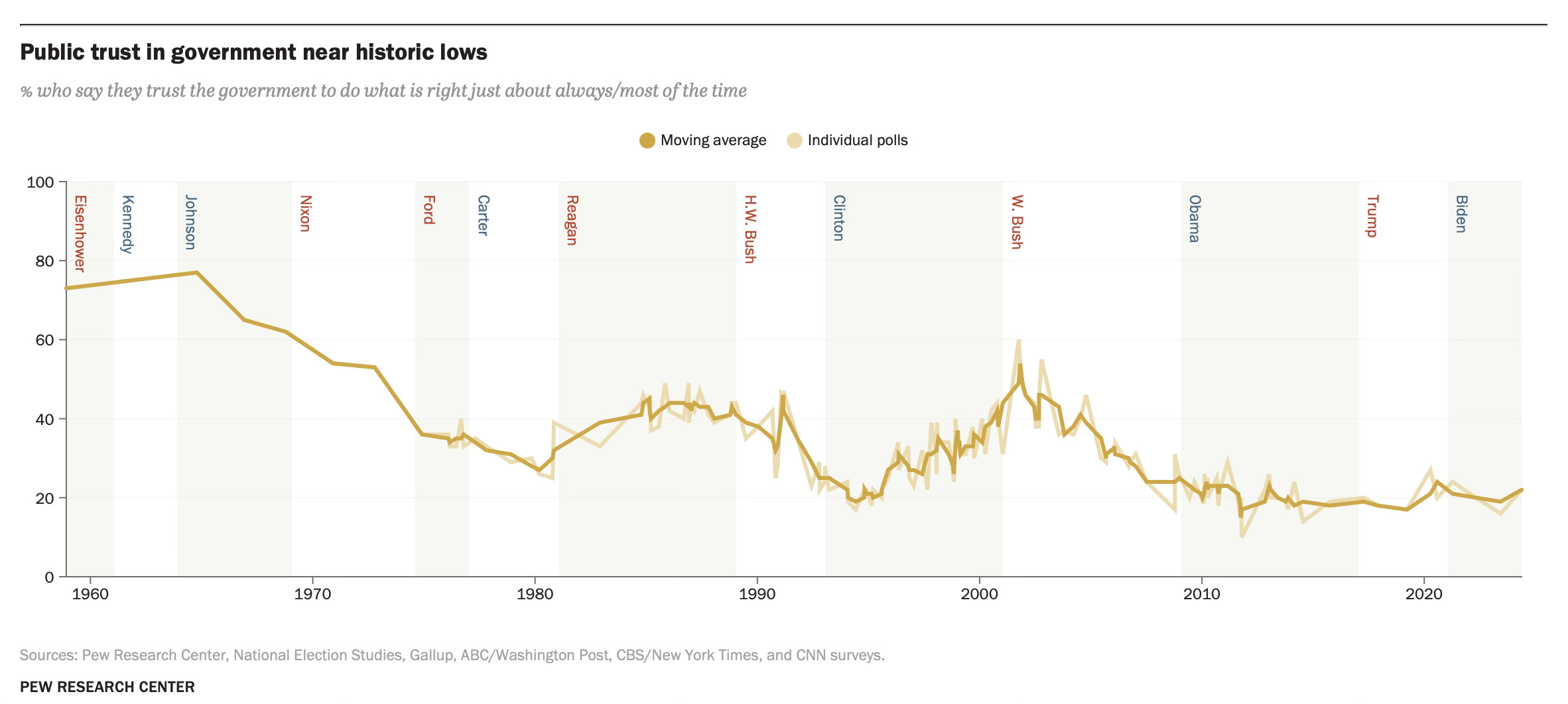
In the US, trust in government has trended toward decline since the 1960s. According to a Pew Research study, only 2% of participants trust the government to “do what is right just about always” and 21% “most of the time.”
Edelman—a global PR consultancy—correlates declining trust in four institutions (business, government, media, and NGOs) with a “crisis of grievance” in their annual trust survey.
They say that 61% of respondents report a moderate to high level of grievance (defined as “a belief that government and business make their lives harder and serve narrow interests, and wealthy people benefit unfairly from the system”).
Notably, a majority of respondents (64% globally, ~80% in developed countries) also believe the next generation will be worse off, and 40% approve of hostile activism to drive change (including 53% of persons aged 18-34).
Why it Matters
What does a future without trust and optimism look like? The baseline scenario (an extension of current trends) includes increasing societal dysfunction, political and economic instability, inequality, and violence, exacerbated by a decline in both perceived and actual human agency.
The Dominant Narrative
The Edelman report concludes that “The institutional failures of the last 25 years have produced grievances around the world, stifling growth and innovation in turn.” They say that institutions should recognize underlying economic realities amongst stakeholders, but stop short of recommending specific solutions that would improve their lived experience. Instead, they argue that businesses, governments, and NGOs should work together to “address root causes” that will lead to new opportunities and thus greater optimism and reduced threat.
Emerging Narratives
Late Stage Capitalism
Criticism of global capitalism is commonplace, with increasing references to “late stage capitalism” in mainstream discourse.
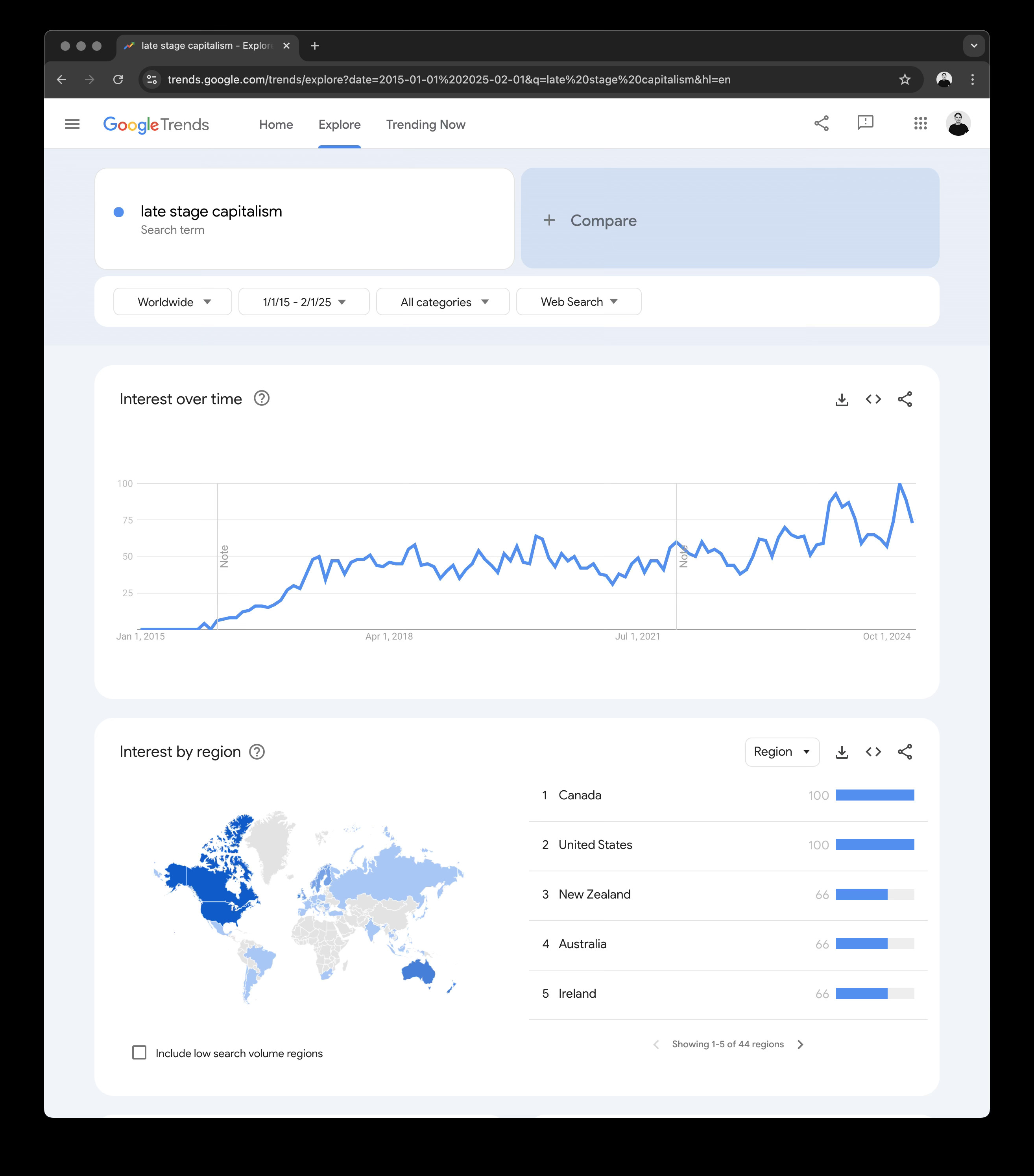
The term itself is not new, but its appearance in the zeitgeist reveals a different and more nuanced explanation for grievance (exploitation, systemic externalities, rising inequality, etc.) thus a different remedy, or at least not more of the same. The “late stage” modifier makes explicit assumptions about a) capitalism comprising discrete and linear stages, and b) the relative inevitability of an end state.
The Polycrisis/Metacrisis
Nihilism and despair are visible in discourses regarding the interconnected set of global crises that include climate change and biodiversity loss, the race for artificial general intelligence, political polarization and populism, inequality, and the loss of meaning, among others. Identifying “root causes” is not a viable strategy in complex systems, where causation is ambiguous and emergent.
The Big Question
Can trust be “rebuilt” by the same system that destroyed it?
Postscript
As with all consultancy research reports, the Edelman Trust Barometer should be taken with a grain of salt, considering the interests of the authors and its intended audience. Framing the issue as “grievance” seems like a deliberate choice to delegitimize the belief that institutions have failed stakeholders and constituents, even as it is asserted.
Consider this reframe: “People who are suffering within the current economic system are more likely to distrust institutions.” Thus the crisis is not grievance, per se, but the material conditions that create it.