
The Future of Work: System of Systems
Appreciating complexity, sensing new pathways, and mapping a research agenda for the future of work

A few weeks ago I wrote about the Future of Work in Three Horizons, illustrating how that framework can be used to create a shared understanding of the emerging dynamics in a system, the underlying assumptions of stakeholders, and their preferred futures.
A limitation of the method is that without skilled facilitation or previous research to guide the discussion, the results may reflect familiar narratives rather than more critical, creative, or transformational perspectives. While Three Horizons can be used as a stand-alone activity, I prefer it as part of a formal foresight program. Following the University of Houston model, this starts with careful framing and desk research to identify emerging signals of change and their implications for the future of a specific domain (Hines & Bishop, 2013).
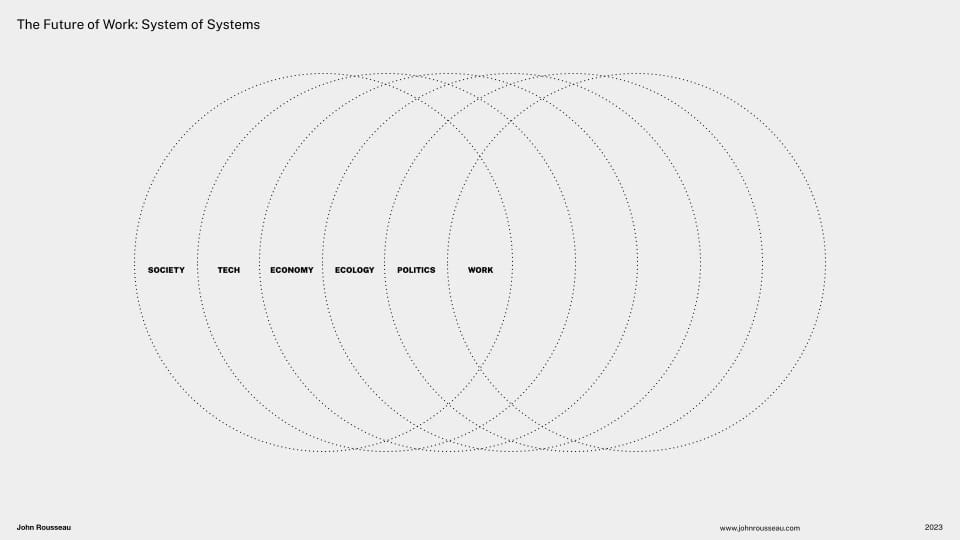
A System of Systems
Work is part of a complex social system that impacts and is impacted by other complex systems that display nonlinear patterns of change and ambiguous causation. Thinking within and across these systems with a lens specific to the future of work expands our understanding of reality and is closer to how the future actually emerges from complex dynamics and interactions. Everything is connected to everything else, and the future is perpetually emerging—which can be overwhelming. We often cope by looking to the past, creating stories that explain social change, and making sense of the future by extrapolating trends in the present (e.g., assuming that future changes will evolve in the same way).
This tendency also explains why expert judgment is so often wrong (Tetlock & Gardner, 2015), and why anyone interested in the future should be skeptical of predictions, straightforward explanations, and mainstream analysis.
Here, the STEEP taxonomy is useful to both broaden and focus perspectives, with the caveat that it is also an artificial construct. Take the overall model and boundaries between categories with a grain of salt, and remember that the map is not the territory, but nonetheless essential for navigation.
Mapping the Domain
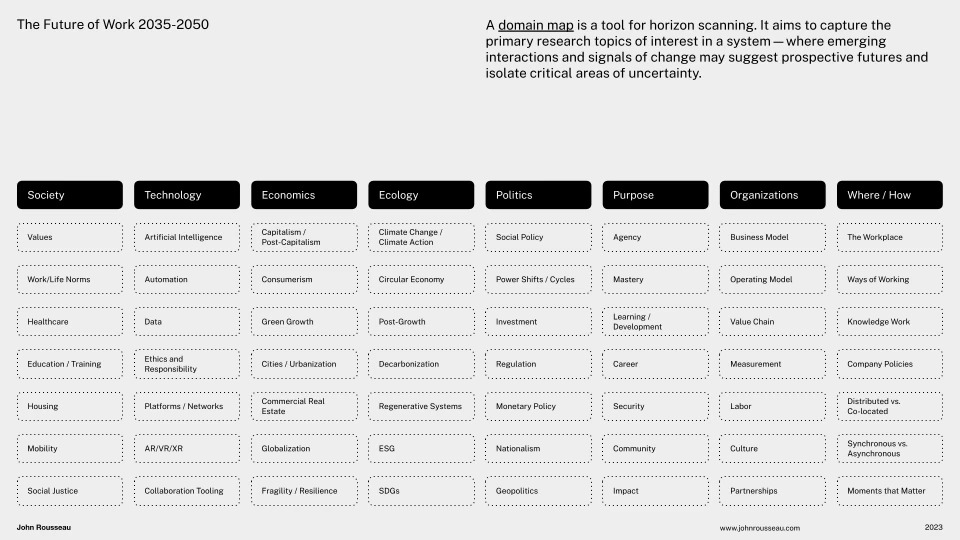
A domain map is a tool for horizon scanning. It aims to capture the primary research topics of interest in a given system—where emerging interactions and signals of change may suggest prospective futures and isolate critical areas of uncertainty. It is not meant to be fixed or exhaustive, and often evolves over the course of a foresight program.
In this example, I modified the Houston approach to integrate STEEP more explicitly1—so the first five columns represent topics relevant to the future of work within each of the STEEP categories. Then, I added additional columns pertaining to key stakeholders (individuals/organizations) and the orchestration of work.
The Myopic View
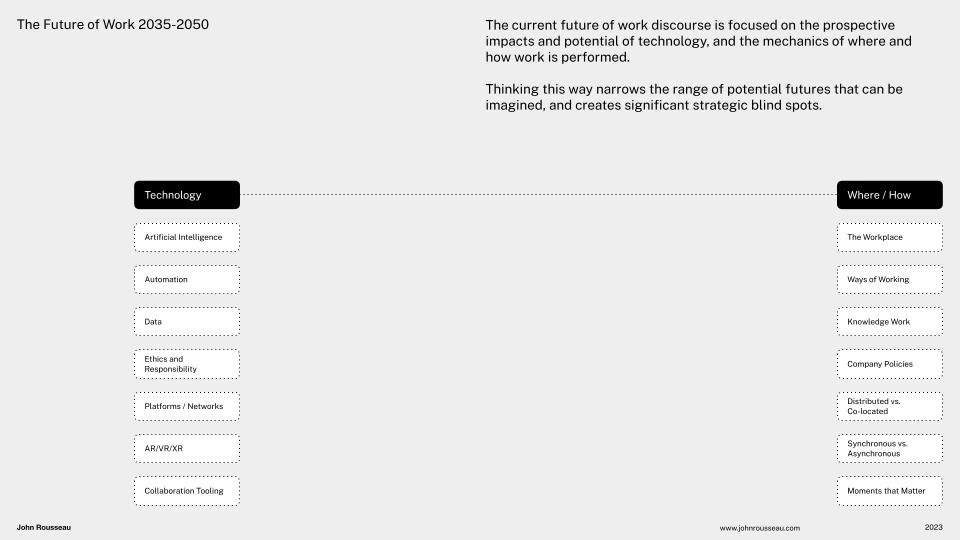
The domain map also highlights gaps in the mainstream perspective—specifically how the current future of work discourse is focused on the prospective impacts and potential of technology, and the mechanics of where and how work is performed.
Thinking this way narrows the range of potential futures that can be imagined, and creates significant strategic and epistemic blind spots, because it misses key signals and implications that may eventually have an outsized influence on the future of work and vice versa (e.g., climate change, education, mobility, etc.).
The Systems View
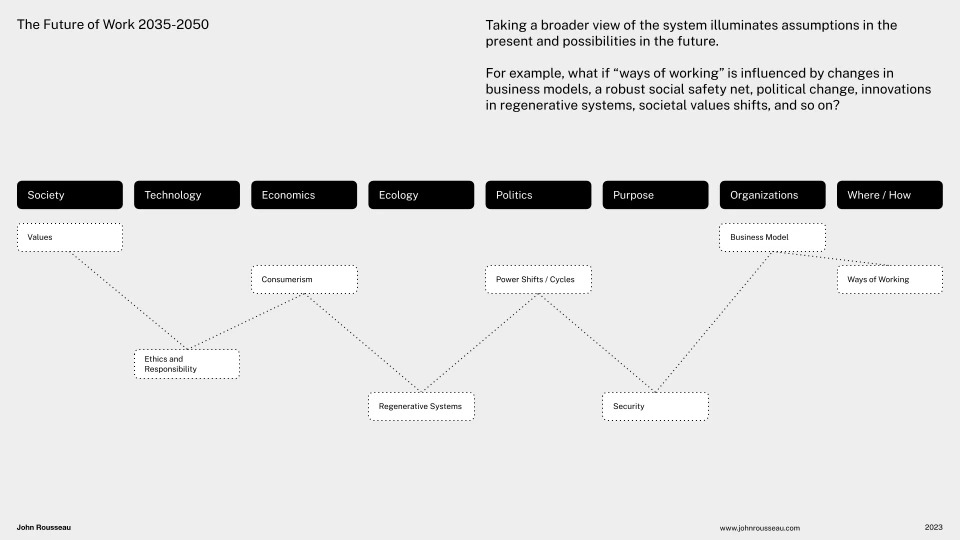
Taking a broader view of the system illuminates assumptions in the present and possibilities in the future. For example, what if “ways of working” is influenced by changes in business models, a robust social safety net, political change, innovations in regenerative systems, societal values shifts, and so on? Or how might those same dynamics emerge differently, and why?
This is one pattern among many that emerge and inform potential research questions. As the program team engages in horizon scanning, researchers look for signals of change across the entire map. The goal is to develop a more thorough understanding of the underlying dynamics, from which key drivers and uncertainties are identified. Eventually, these ingredients become the building blocks of theories of change rendered through future scenarios.
Or possibly—a transformative Three Horizons workshop.
Notes
1. The University of Houston Framework Foresight approach allows for differing interpretations of the domain map, which should be tailored to the needs of a specific program and research topic. See the references below for more information.
References
Foresight resources. Houston Foresight. https://www.houstonforesight.org/foresight-resources/
Hines, A., & Bishop, P. (2013). Framework foresight: Exploring futures the Houston way. Futures, 51, 31–49. https://doi.org/10.1016/j.futures.2013.05.002
Tetlock, P., & Gardner, D. (2015). Superforecasting: The Art and Science of Prediction. Random House.