
Opening the Future
Three ways to integrate strategic foresight during uncertain times

It seems that strategic foresight is least appealing when organizations need it most, during periods of rapid change and high levels of uncertainty like the present. Turbulent conditions beget conservatism and it is understandable that business leaders choose to focus on what is proximate and under their control.
And yet, these common habits of mind and behavior limit their ability to perceive change and make sense of new information. Organizations adopt comfortable scenarios with significant blind spots and based on tacit assumptions that support the status quo. Leaders become less receptive to evidence that contradicts established narratives and are more likely to rely on default practices or be overly influenced by the hype cycle. Images of the future become narrow and myopic, which in turn limit the firm’s ability to adapt and proactively meet new challenges.
All of which compromises long-term resilience—the opposite of what was intended.
So how might leaders build greater foresight capacity, open the future, and catalyze change?
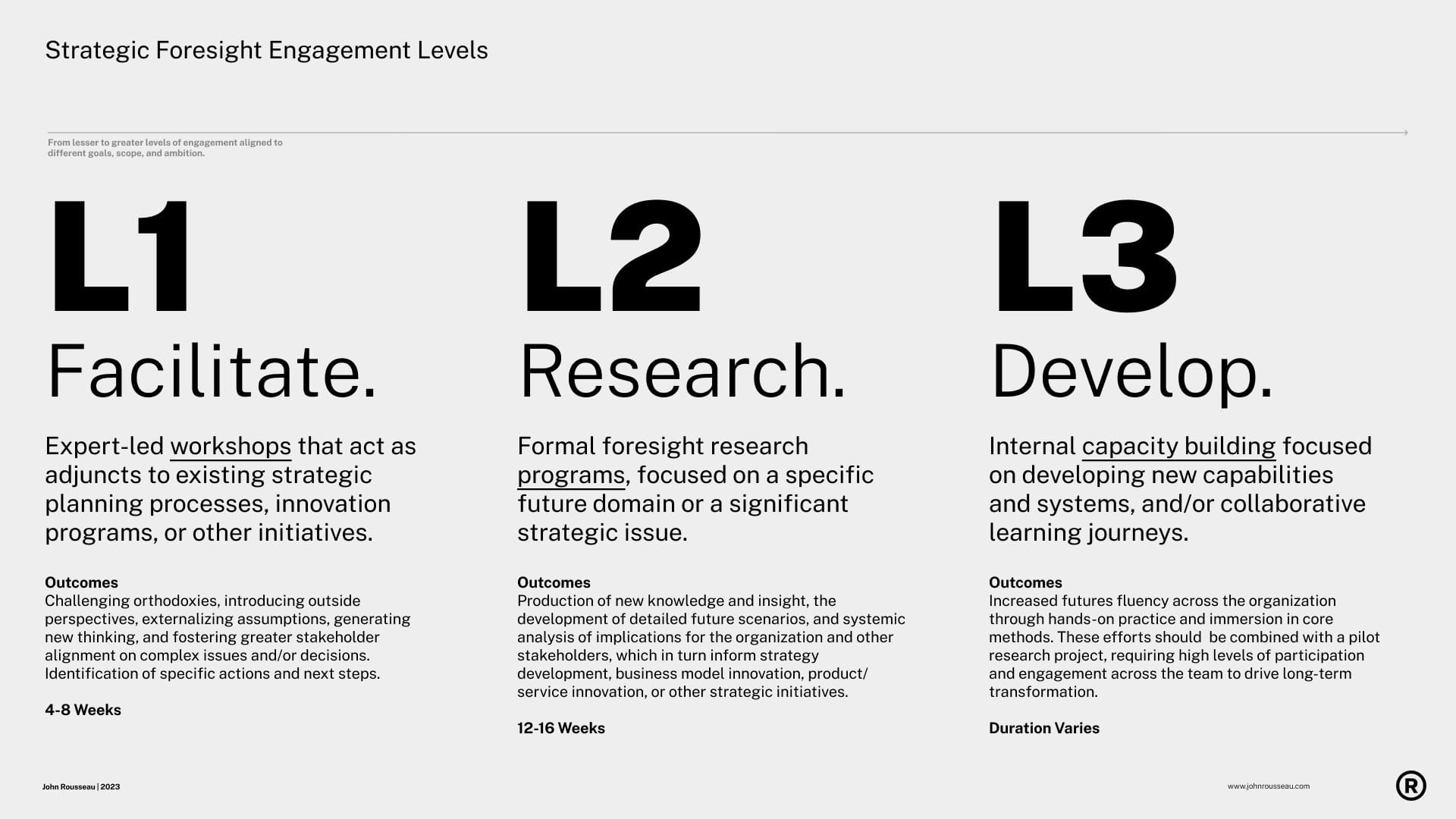
Here, I suggest three levels of engagement pertaining to different goals. Note that these recommendations are directed at corporate foresight, and are aligned to strategy and innovation activities with a bias toward action. There are many methodological variants and approaches. Programs should always be tailored to specific business needs and desired outcomes.
Level 1: Facilitate
Level 1 is modest in scope—a way of introducing foresight to address a focused need and counter the most common blind spots. Here, expert-led workshops act as adjuncts to existing strategic planning processes, innovation programs, or other initiatives. The primary value of these sessions is in challenging orthodoxies, introducing outside perspectives, externalizing assumptions, generating new thinking, and fostering greater stakeholder alignment on complex issues and/or decisions. Meetings should be carefully designed for each organization and group of participants with specific outcomes in mind and a bias toward action, clear next steps, and accountability.
Level 2: Research
Level 2 is more involved and refers to formal foresight research programs, focused on a specific future domain (e.g., the future of work) or a significant strategic issue (e.g., the implications of AI and automation). The primary value of these programs is the production of new knowledge and insight, the development of detailed future scenarios, and systemic analysis of implications for the organization and other stakeholders, which in turn inform strategy development, business model innovation, product/service innovation, or other strategic initiatives.
Level 3: Develop
Level 3 requires the most significant investment of resources. This includes internal capacity building focused on developing new capabilities and systems (e.g., establishing a horizon scanning practice or integrating foresight across specific functions). It may also include the design and orchestration of collaborative learning journeys for internal teams, and/or long-term coaching and advisory services through fractional leadership. The primary value of these activities is increased futures fluency across the organization through hands-on practice and immersion in core methods, and the ability to apply foresight more broadly on a day-to-day basis. These efforts should be combined with a pilot research project, requiring high levels of participation and engagement across the internal team to drive long-term transformation.